4. NEURORECURSIVE SCULPTURE (Onto Cybernetic Sculpture)
Academic Text
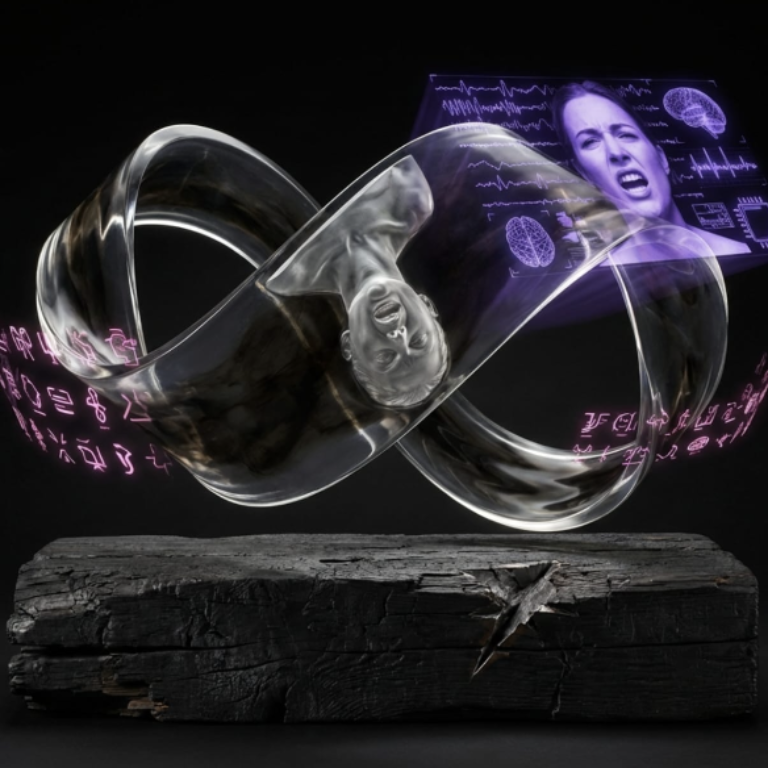
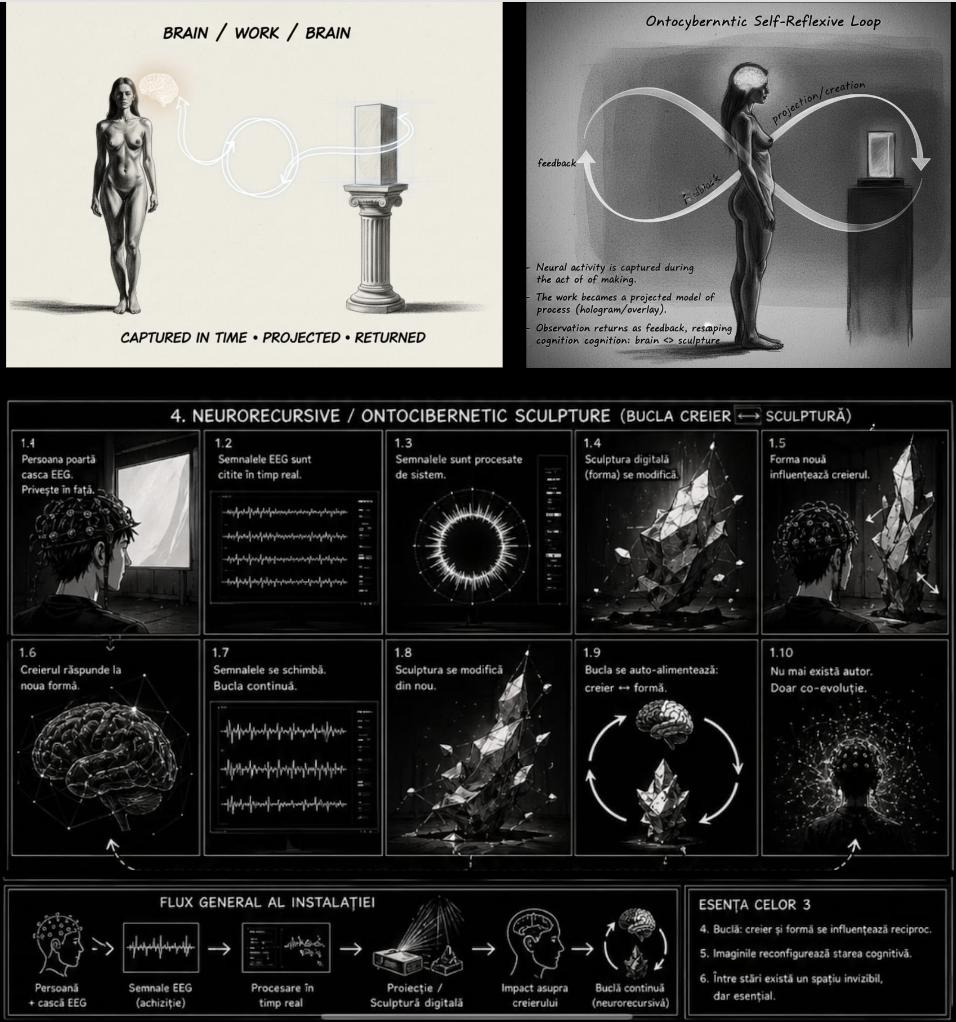
Neurorecursive sculpture proposes a radical redefinition of sculptural ontology by integrating neural data acquisition (EEG), conversion software, and volumetric projection into a recursive perceptive system. The sculptor, equipped with an EEG device, generates neural signatures during the act of creation. These signals are translated via software into holographic or projected forms, which are then reintroduced through sight back into the perceptive field of the brain. This establishes an infinite loop of cognitive neural feedback, in which, at an abstract ontological level, the brain sculpts the sculpture, and the sculpture sculpts the brain. Unlike traditional sculpture, where the object is static and external, here the object becomes an active cognitive agent. The sculptural form evolves not only during its creation, but continues to transform through feedback, perception, and interaction. The paradigm allows for multiple configurations: internal loop (artist + EEG + projection), externalized loop (audience feedback via eye tracking / motion capture), and post-creation recursivity (the projection of the creation process onto the finished object).
Statement
Neurorecursive sculpture redefines sculpture as a closed cognitive loop where the brain generates form, form re-enters perception, and perception reconfigures the brain. The sculptural act is no longer linear, but recursive: a system of continuous feedback in which neural activity becomes both the origin and the consequence of form. In this paradigm, sculpture does not merely represent thought; it functions as a self-modifying system of knowledge. The object, the process, and the observer merge into a single neuro-dynamic circuit. The brain sculpts, and the sculpture sculpts the brain. The infinite becomes present.
Principles
- Recursive ontology, sculpture exists as a loop, not as an object.
- Neuro-feedback integration, EEG data is not auxiliary — it is constitutive.
- Visibility of the process, the act of creation becomes part of the final form.
- Cognitive plasticity through form, the sculpture modifies the neural state that generated it.
- Inclusion of the observer, the public can enter the feedback loop.
What is new?
For the first time, the cerebral process of creation becomes part of the final sculpture. “The brain sculpts and the sculpture sculpts the brain” is transformed into a measurable loop. The artwork contains and redisplays its own process of neural birth. Sculpture tends to turn from an object into a cyber interface of consciousness.
5. INMIND SCULPTURE / (Cognitive reconfiguration sculpture)
Academic Text
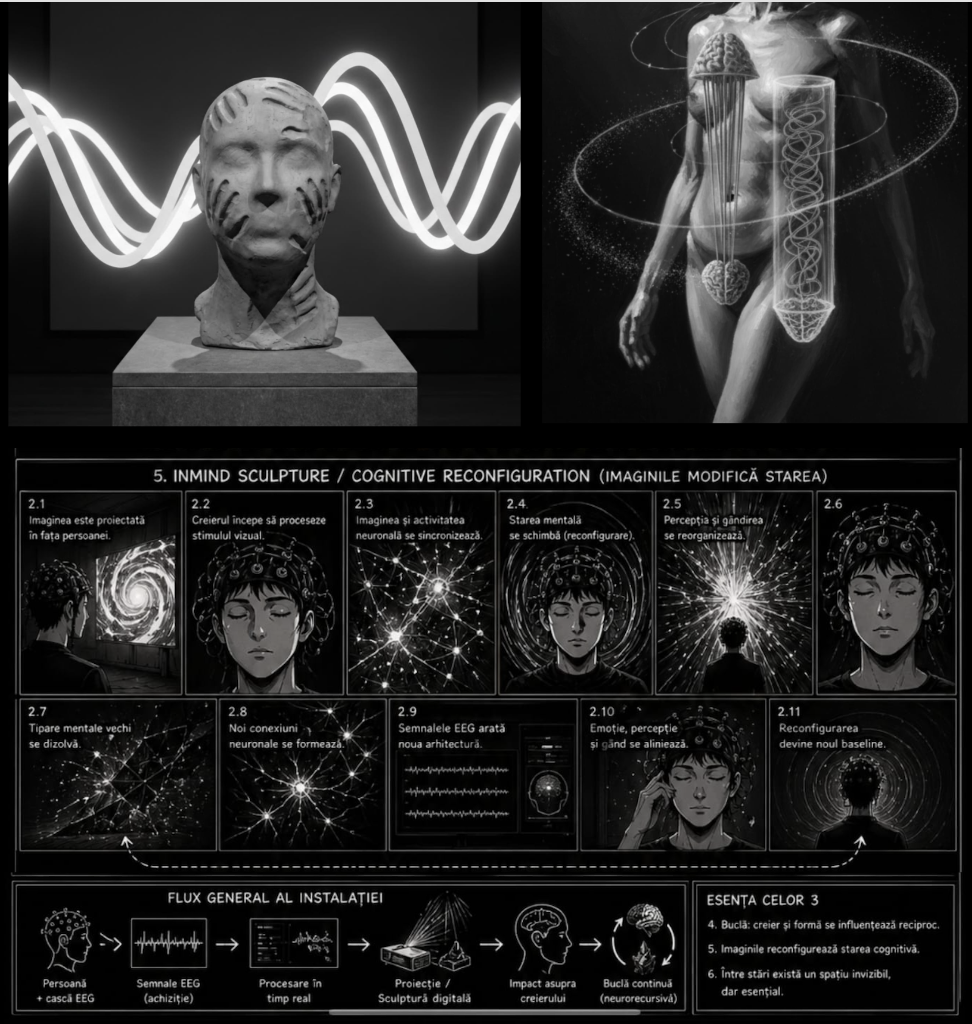
InMind Sculpture proposes a shift from the contemplative function of the image to its role as a generator of mental states. Within this framework, the artwork does not function as a representative object, but as a stimulus that actively engages and models cognitive and affective processes. Through the integration of EEG-based systems, neural activity is translated in real time into a chromatic visual field. States such as stress or calmness are not represented symbolically, but are rendered directly perceptible through dynamic visual feedback. The viewer does not exercise control over the image itself, but rather over their own internal states, using the visual feedback as a mechanism for conscious self-regulation. InMind Sculpture (Cognitive Reconfiguration Sculpture) establishes a direct correlation between measurable neural states and dynamic visual form. By means of EEG data, mental states such as calmness, stress, and focus are translated into distinct and transformable visual morphologies: calmness → fluid, continuous structures in tones of blue; stress → fragmented, unstable geometries in red; focus → stable, coherent configurations. The sculptor observes these transformations in real time, creating a feedback loop not through recursivity, but through self-awareness.
Statement
InMind Sculpture transforms mental states into visual structures in real time, allowing the mind to observe and regulate itself through form and color. It is neither therapy nor representation, but a direct cognitive interface in which perception becomes a tool for self-reconfiguration. The mind observes itself and reconfigures through visual form.
Principles
- Direct cognitive visualization, mental states become visible structures.
- Non-invasive feedback, without intervention beyond perception.
- Self-regulation through awareness, change occurs internally, not algorithmically.
- Real-time transformation, the sculpture evolves along with the mind.
- Cognition manifested in visual form, the viewer and the system are one.
What is new?
Mental states become sculptural material in real time. The artist can observe and visually modify their own cognitive processes. Sculpture functions as an interface between consciousness and its visual representation.
6. MINDGAP SCULPTURE (Interstice Sculpture)
Academic Text
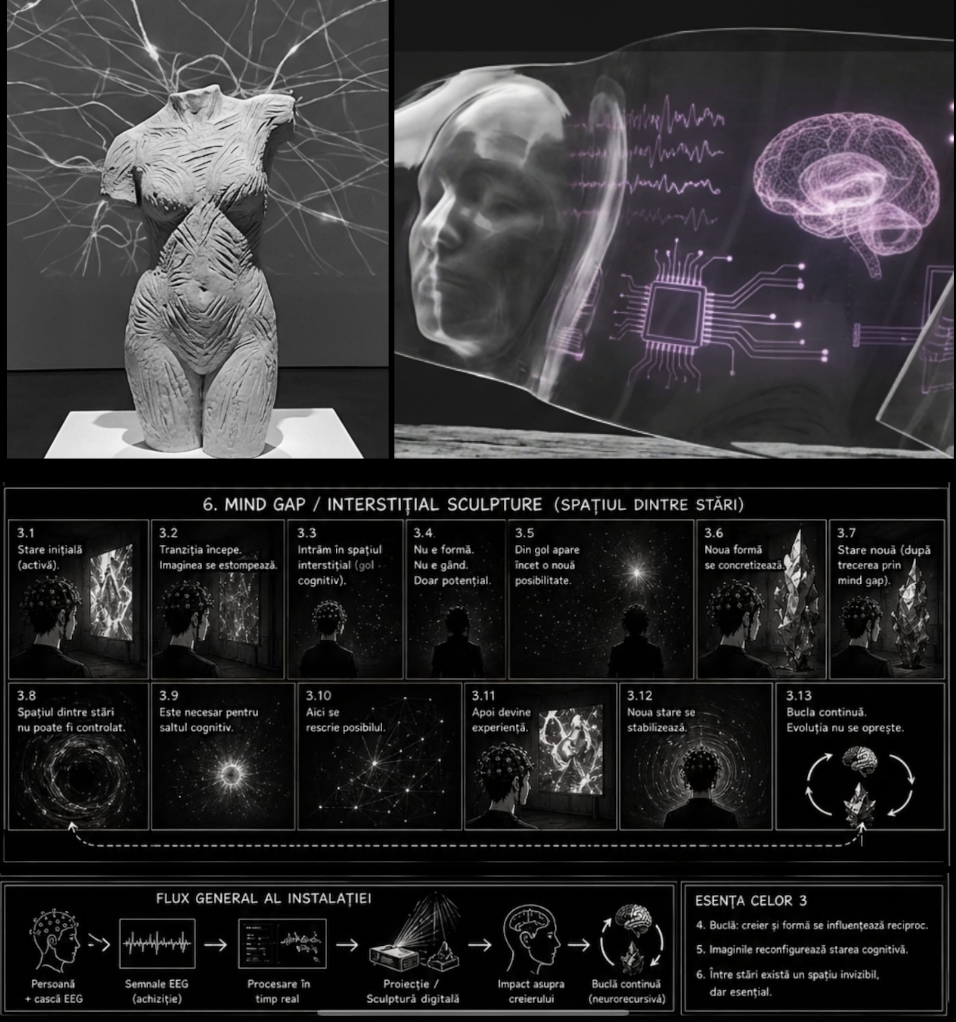
Mind Gap Sculpture (Interstice Sculpture) shifts the focus of sculptural practice from presence to absence, from form to interval, and from matter to cognitive void. Using EEG-mediated projection, the sculptor enters a meditative state in which neural activity is progressively filtered rather than amplified. Unlike the neurorecursive system, this paradigm does not aim to visualize active cognition, but to reduce cognitive noise, allowing the emergence of interstitial perception, the anti-space between thoughts. The sculptural result is immaterial, often holographic, and reflects decreasing neural fluctuations, the emergence of stillness, and the spatialization of silence. The sculptural form appears as the very interstice between thoughts. Through meditative concentration, the artist operates in a state of meditative detachment, minimizing cognitive noise and allowing the system to register gaps, pauses, and intervals. These cease to represent absences, but rather active fields. The resulting projection does not visualize thought. It makes perceptible the space where thought ceases. The public experiences this space from the outside, as a visual and spatial phenomenon.
Statement
Mind Gap Sculpture reveals the invisible intervals between thoughts, transforming cognitive silence into a perceptible form. The true form of the sculpture is the invisible interval between thoughts.
Principles
- Sculpting the interval, the space between thoughts becomes a perceptible cognitive medium.
- Sculpture is defined by perception, not by physical mass.
- Cognitive filtering, EEG data is reduced toward stillness, not toward expression.
- Meditative detachment, the artist accesses deeper cognitive layers through non-action.
- Emergent phenomenon, the artwork is not an object, but a state-event.
What is new?
It sculpts neither matter nor information, but the interval between thoughts. It introduces the “interstitial space of the mind” as a new sculptural territory. The artistic object becomes a reference point for perceiving absence and cognitive silence.
The code is the interactive principle that structures the ontological expression of the existential adventure called Neurophysiological Shapings.
Initially, the code exists in a latent state within the concept itself. It is present as a potential structure before taking visible form.
Its first manifestation appears through the ontorhizomic drawing. It gains material embodiment through Pictosculpture and takes sculptural form as Rebound Core, the inherited sculptural structure underlying the sculptural paradigms of Cortextualism.
The code then extends into the cognitive domain where perception, attention, mental states, and self-reflection become sculptural processes. Through the EEG paradigms, these processes become visible as dynamic interactions between brain activity, form, cognition, and the spaces between thoughts.
The code is not an object but a process of activation. It unfolds from concept to drawing, from drawing to Pictosculpture, from Pictosculpture to Rebound Core, from Rebound Core to Cognitive Sculpture, and from Cognitive Sculpture to the EEG paradigms.
PARADIGMS
4. NEURORECURSIVE SCULPTURE (Onto Cybernetic Sculpture)
Academic Text
Neurorecursive sculpture proposes a radical redefinition of sculptural ontology by integrating neural data acquisition (EEG), conversion software, and volumetric projection into a recursive perceptive system. The sculptor, equipped with an EEG device, generates neural signatures during the act of creation. These signals are translated via software into holographic or projected forms, which are then reintroduced through sight back into the perceptive field of the brain. This establishes an infinite loop of cognitive neural feedback, in which, at an abstract ontological level, the brain sculpts the sculpture, and the sculpture sculpts the brain. Unlike traditional sculpture, where the object is static and external, here the object becomes an active cognitive agent. The sculptural form evolves not only during its creation, but continues to transform through feedback, perception, and interaction. The paradigm allows for multiple configurations: internal loop (artist + EEG + projection), externalized loop (audience feedback via eye tracking / motion capture), and post-creation recursivity (the projection of the creation process onto the finished object).
Statement
Neurorecursive sculpture redefines sculpture as a closed cognitive loop where the brain generates form, form re-enters perception, and perception reconfigures the brain. The sculptural act is no longer linear, but recursive: a system of continuous feedback in which neural activity becomes both the origin and the consequence of form. In this paradigm, sculpture does not merely represent thought; it functions as a self-modifying system of knowledge. The object, the process, and the observer merge into a single neuro-dynamic circuit. The brain sculpts, and the sculpture sculpts the brain. The infinite becomes present.
Principles
- Recursive ontology, sculpture exists as a loop, not as an object.
- Neuro-feedback integration, EEG data is not auxiliary — it is constitutive.
- Visibility of the process, the act of creation becomes part of the final form.
- Cognitive plasticity through form, the sculpture modifies the neural state that generated it.
- Inclusion of the observer, the public can enter the feedback loop.
What is new?
For the first time, the cerebral process of creation becomes part of the final sculpture. “The brain sculpts and the sculpture sculpts the brain” is transformed into a measurable loop. The artwork contains and redisplays its own process of neural birth. Sculpture tends to turn from an object into a cyber interface of consciousness.
5. INMIND SCULPTURE / (Cognitive reconfiguration sculpture)
Academic Text
InMind Sculpture proposes a shift from the contemplative function of the image to its role as a generator of mental states. Within this framework, the artwork does not function as a representative object, but as a stimulus that actively engages and models cognitive and affective processes. Through the integration of EEG-based systems, neural activity is translated in real time into a chromatic visual field. States such as stress or calmness are not represented symbolically, but are rendered directly perceptible through dynamic visual feedback. The viewer does not exercise control over the image itself, but rather over their own internal states, using the visual feedback as a mechanism for conscious self-regulation. InMind Sculpture (Cognitive Reconfiguration Sculpture) establishes a direct correlation between measurable neural states and dynamic visual form. By means of EEG data, mental states such as calmness, stress, and focus are translated into distinct and transformable visual morphologies: calmness → fluid, continuous structures in tones of blue; stress → fragmented, unstable geometries in red; focus → stable, coherent configurations. The sculptor observes these transformations in real time, creating a feedback loop not through recursivity, but through self-awareness.
Statement
InMind Sculpture transforms mental states into visual structures in real time, allowing the mind to observe and regulate itself through form and color. It is neither therapy nor representation, but a direct cognitive interface in which perception becomes a tool for self-reconfiguration. The mind observes itself and reconfigures through visual form.
Principles
- Direct cognitive visualization, mental states become visible structures.
- Non-invasive feedback, without intervention beyond perception.
- Self-regulation through awareness, change occurs internally, not algorithmically.
- Real-time transformation, the sculpture evolves along with the mind.
- Cognition manifested in visual form, the viewer and the system are one.
What is new?
Mental states become sculptural material in real time. The artist can observe and visually modify their own cognitive processes. Sculpture functions as an interface between consciousness and its visual representation.
6. MINDGAP SCULPTURE (Interstice Sculpture)
Academic Text
Mind Gap Sculpture (Interstice Sculpture) shifts the focus of sculptural practice from presence to absence, from form to interval, and from matter to cognitive void. Using EEG-mediated projection, the sculptor enters a meditative state in which neural activity is progressively filtered rather than amplified. Unlike the neurorecursive system, this paradigm does not aim to visualize active cognition, but to reduce cognitive noise, allowing the emergence of interstitial perception, the anti-space between thoughts. The sculptural result is immaterial, often holographic, and reflects decreasing neural fluctuations, the emergence of stillness, and the spatialization of silence. The sculptural form appears as the very interstice between thoughts. Through meditative concentration, the artist operates in a state of meditative detachment, minimizing cognitive noise and allowing the system to register gaps, pauses, and intervals. These cease to represent absences, but rather active fields. The resulting projection does not visualize thought. It makes perceptible the space where thought ceases. The public experiences this space from the outside, as a visual and spatial phenomenon.
Statement
Mind Gap Sculpture reveals the invisible intervals between thoughts, transforming cognitive silence into a perceptible form. The true form of the sculpture is the invisible interval between thoughts.
Principles
- Sculpting the interval, the space between thoughts becomes a perceptible cognitive medium.
- Sculpture is defined by perception, not by physical mass.
- Cognitive filtering, EEG data is reduced toward stillness, not toward expression.
- Meditative detachment, the artist accesses deeper cognitive layers through non-action.
- Emergent phenomenon, the artwork is not an object, but a state-event.
What is new?
It sculpts neither matter nor information, but the interval between thoughts. It introduces the “interstitial space of the mind” as a new sculptural territory. The artistic object becomes a reference point for perceiving absence and cognitive silence.
The code is the interactive principle that structures the ontological expression of the existential adventure called Neurophysiological Shapings.
Initially, the code exists in a latent state within the concept itself. It is present as a potential structure before taking visible form.
Its first manifestation appears through the ontorhizomic drawing. It gains material embodiment through Pictosculpture and takes sculptural form as Rebound Core, the inherited sculptural structure underlying the sculptural paradigms of Cortextualism.
The code then extends into the cognitive domain where perception, attention, mental states, and self-reflection become sculptural processes. Through the EEG paradigms, these processes become visible as dynamic interactions between brain activity, form, cognition, and the spaces between thoughts.
The code is not an object but a process of activation. It unfolds from concept to drawing, from drawing to Pictosculpture, from Pictosculpture to Rebound Core, from Rebound Core to Cognitive Sculpture, and from Cognitive Sculpture to the EEG paradigms.